I work in a very hands-on area of study so naturally I have a hard time finding too many forms of digital teaching relevant. While the interwebs can be useful for helping students remember techniques that they've learnt in the workshop, the practical learning usually needs to happen in-house, in person, with steel toed boots on.
The timing of the Balkanized Internet article couldn't be more relevant. Just as the American FCC moves to make Internet access more expensive, more limited, and more specifically-oriented toward websites and services that are profitable for the ISP (regardless of their utility to or desirability for consumers) we are reminded that access to Internet and computing hardware is already polarised and becoming more so as ISPs limit access to the cables themselves to the poor, the rural, and the already-underserved. Of course!
Okay, Marc Prensky's Natives-Immigrants article is downright obscene. This Web 1.0 guy from 2001 pretending that his students are digital natives because they watched MTV? He was a passive consumer of TV from childhood just like everyone else. That making people play games to learn key skills, try to piece together learning out of hundreds of thirty-second sound bytes, and tolerate advice from an anthropomorphous paper clip was going to benefit more than four per cent of the population? Oh man. I've got a skill you might try to teach over the 'net, but probably shouldn't. We've learned that you really shouldn't have your only skills training for power tools come from videos. At the very least, if you're going to learn how to use your circular saw from YouTube make sure your flatmate is a First Aider. Or at least has an ambulance on speed dial. Oh the digital millennium. How clever we all thought we were.
I'm on board with the Critical Digital Pedagogy article's crux--the interwebs, the computers, the VoIP and video conferencing--these things are tools that can either facilitate or support learning. Ultimately we still learn the way we always did, but now we can do it from further away, or at least in the comfort of our own homes. For some things. If we want to.
Tuesday, November 28, 2017

Monday, November 27, 2017
November 15: Pedagogical Persona critical reflection
PC: Counterweight Flying Exercise. Challenged and maintained the interest of specific students for whom classroom exercise was relevant.
Tone was relaxed, playful, with a touch of snark that the students appeared to appreciate when they screwed up.
Did not appear to take safety as seriously as exercise indicated.
Did not attempt to engage the attention of the greater majority of the class, who spent most of the day standing or sitting around being annoyed with each other, not paying attention, and getting in the way.
NM: Semiotics Lecture.
The lecturer covered the topic's key points quickly but with warmth and humour. He sought repeatedly to relate the content to the assembled students' areas of study.
The lecture was fast and very light-touch. This was by necessity and design: the class was only an hour long, and it was an introductory overview for first years who may or may not have a genuine interest in the field of study.
Students were not afforded more than cursory opportunities to participate or contribute to the content of the lecture; questions posed to the group were either rhetorical or the lecturer answered them for himself before the students had a chance to digest the question. This may have been due to time constraints, but it felt as though the windows to invite the students to respond were largely perfunctory. He had no real desire to hear their thoughts or even check that they comprehended, which was all the more ironic in a class about communication and understanding.
The space was small, warm and airless. Students started nodding off at about the 40 minute mark. It was difficult to measure attention. Some people actually pay attention quite well when staring off into the middle distance, which I find disconcerting.
The lecturer's tone was warm and engaging but some content was objectionable and led to a palpable disconnect between him and the students. The lecturer referred to theatre as 'pretend' and indicated that the dual usage of the word 'play' to mean 'piece of theatre' and 'children's imaginative activity' was relevant and deliberate. I find the shared usage of this word frustrating and avoid it, as do many theatre and performance makers who find the term infantilising and trivialising. As a way to introduce semiotics it may have felt apt, but it was distracting and may have engendered distrust. Particularly among crafts makers, for whom much of their work and skill is decidedly not pretend.
The overall impression I received was that the tutor was ultimately disgruntled with the subject and found teaching this particular lesson trying. This may have developed out of a former enthusiasm for semiotics that was not shared by a class, or several classes' worth of students, but while he understood the material to a significant depth he didn't seem to have it in him to give much of a hoot about it. It was difficult to tell where this struggle originated, if his attitude today toward the subject caused or was caused by the miasma of apathy that hovered in the room.
Tone was relaxed, playful, with a touch of snark that the students appeared to appreciate when they screwed up.
Did not appear to take safety as seriously as exercise indicated.
Did not attempt to engage the attention of the greater majority of the class, who spent most of the day standing or sitting around being annoyed with each other, not paying attention, and getting in the way.
NM: Semiotics Lecture.
The lecturer covered the topic's key points quickly but with warmth and humour. He sought repeatedly to relate the content to the assembled students' areas of study.
The lecture was fast and very light-touch. This was by necessity and design: the class was only an hour long, and it was an introductory overview for first years who may or may not have a genuine interest in the field of study.
Students were not afforded more than cursory opportunities to participate or contribute to the content of the lecture; questions posed to the group were either rhetorical or the lecturer answered them for himself before the students had a chance to digest the question. This may have been due to time constraints, but it felt as though the windows to invite the students to respond were largely perfunctory. He had no real desire to hear their thoughts or even check that they comprehended, which was all the more ironic in a class about communication and understanding.
The space was small, warm and airless. Students started nodding off at about the 40 minute mark. It was difficult to measure attention. Some people actually pay attention quite well when staring off into the middle distance, which I find disconcerting.
The lecturer's tone was warm and engaging but some content was objectionable and led to a palpable disconnect between him and the students. The lecturer referred to theatre as 'pretend' and indicated that the dual usage of the word 'play' to mean 'piece of theatre' and 'children's imaginative activity' was relevant and deliberate. I find the shared usage of this word frustrating and avoid it, as do many theatre and performance makers who find the term infantilising and trivialising. As a way to introduce semiotics it may have felt apt, but it was distracting and may have engendered distrust. Particularly among crafts makers, for whom much of their work and skill is decidedly not pretend.
The overall impression I received was that the tutor was ultimately disgruntled with the subject and found teaching this particular lesson trying. This may have developed out of a former enthusiasm for semiotics that was not shared by a class, or several classes' worth of students, but while he understood the material to a significant depth he didn't seem to have it in him to give much of a hoot about it. It was difficult to tell where this struggle originated, if his attitude today toward the subject caused or was caused by the miasma of apathy that hovered in the room.
Monday, November 6, 2017
November 8: Ways of Learning
Biggs And Collis Structure of Learned Outcomes: This looks and feels just like Bloom's taxonomy. How is it different? Very familiar, I'm comfortable with this one.
Costa and Callick: Critical Friend. This is fraught with peril. This does not describe a friendship, it describes maybe mentorship or just being a wiser and not-very-nice older sister. Anyone who has the ability to criticise you but who you can't give back a taste of their own medicine isn't a friend. Friendship must go both ways or it is disingenuous. I don't like this one, or trust the intentions of the authors. At best it is what I do at work--I am friendly and not in a position to grade the students, but I have helpful feedback and can be playful and silly with the students. I hope that they can grow to trust me. But I am not their friend.
Whitmore's Grow Model: we engaged with this to an extent at the beginning of class, and it is something I have to encounter periodically in professional appraisals and development. The idea of motivating a staff member to set clear, specific, measurable and time-bound goals is at the core of annual appraisal. The idea of finding or creating the willpower to achieve the objectives she has set is where it all falls down.
Caine and Caine: Brain-Based Learning. I'm not sure how I engage with this one. The author appears to indicate that he doesn't either. I guess at its core is a reminder that learners have brains too, and they're probably a lot like yours and need to be stimulated in the right way in order to not only learn, but retain, and have a drive to learn. Ask questions. Pose a challenging but not overwhelming learning environment. Allow the learner to have some autonomy in how and what they learn, if possible.
Gardner: Multiple Intelligences. This seems silly. It lacks substance, either because Gardner's thinking lacked substance or because Bob Bates didn't take it particularly seriously. It doesn't help people learn what they signed up to learn, certainly, and doesn't appear to have a whole lot of use in the classroom if ultimately you have specific concepts and skills you wish to teach to everyone. Yes we can appreciate that everyone has their aptitudes and range of interests, but how can we tune each intelligence toward learning the thing that needs to be learnt? ("The answers to questions of this nature are not easy." HA!)
Montessori: The Absorbent Mind. I can take a lot of the advice to heart: people thrive where there is order and everything has its place. Facilitate learning rather than dictate teaching. I think the workshop is a much saner place now that we have a tool room. Everything has its place--it may not be the most specific place, but it is much more specific than it used to be, and the space makes more sense. Things don't get lost as easily. I also appreciate my permission to encourage students to make mistakes and learn from them. It's difficult for the students to appreciate just how beautiful a feeling that can be.
Bruner: Discovery learning. Ask students what they want to learn. Help them learn it. Figure out if they understand it. Ask them what they want to learn tomorrow. Great for drop-ins. Not great if the students don't actually want to learn what you are tasked with teaching them, but never mind.
Vygotsky: Zone of Proximal Development. Break the concept down into smaller chunks, and allow the learners to feed them to themselves, or get students who other students pick things up from easily to help feed it to them. Makes concepts sound a lot like soup.
Costa and Callick: Critical Friend. This is fraught with peril. This does not describe a friendship, it describes maybe mentorship or just being a wiser and not-very-nice older sister. Anyone who has the ability to criticise you but who you can't give back a taste of their own medicine isn't a friend. Friendship must go both ways or it is disingenuous. I don't like this one, or trust the intentions of the authors. At best it is what I do at work--I am friendly and not in a position to grade the students, but I have helpful feedback and can be playful and silly with the students. I hope that they can grow to trust me. But I am not their friend.
Whitmore's Grow Model: we engaged with this to an extent at the beginning of class, and it is something I have to encounter periodically in professional appraisals and development. The idea of motivating a staff member to set clear, specific, measurable and time-bound goals is at the core of annual appraisal. The idea of finding or creating the willpower to achieve the objectives she has set is where it all falls down.
Caine and Caine: Brain-Based Learning. I'm not sure how I engage with this one. The author appears to indicate that he doesn't either. I guess at its core is a reminder that learners have brains too, and they're probably a lot like yours and need to be stimulated in the right way in order to not only learn, but retain, and have a drive to learn. Ask questions. Pose a challenging but not overwhelming learning environment. Allow the learner to have some autonomy in how and what they learn, if possible.
Gardner: Multiple Intelligences. This seems silly. It lacks substance, either because Gardner's thinking lacked substance or because Bob Bates didn't take it particularly seriously. It doesn't help people learn what they signed up to learn, certainly, and doesn't appear to have a whole lot of use in the classroom if ultimately you have specific concepts and skills you wish to teach to everyone. Yes we can appreciate that everyone has their aptitudes and range of interests, but how can we tune each intelligence toward learning the thing that needs to be learnt? ("The answers to questions of this nature are not easy." HA!)
Montessori: The Absorbent Mind. I can take a lot of the advice to heart: people thrive where there is order and everything has its place. Facilitate learning rather than dictate teaching. I think the workshop is a much saner place now that we have a tool room. Everything has its place--it may not be the most specific place, but it is much more specific than it used to be, and the space makes more sense. Things don't get lost as easily. I also appreciate my permission to encourage students to make mistakes and learn from them. It's difficult for the students to appreciate just how beautiful a feeling that can be.
Bruner: Discovery learning. Ask students what they want to learn. Help them learn it. Figure out if they understand it. Ask them what they want to learn tomorrow. Great for drop-ins. Not great if the students don't actually want to learn what you are tasked with teaching them, but never mind.
Vygotsky: Zone of Proximal Development. Break the concept down into smaller chunks, and allow the learners to feed them to themselves, or get students who other students pick things up from easily to help feed it to them. Makes concepts sound a lot like soup.
Friday, November 3, 2017
November 1: Constructive Alignment
Gist: If you want people to learn a thing, ensure that the process of teaching them that thing involves doing the thing, or engaging with it. Best example: if you seek to teach someone to drive a car, do so in the car, with them driving it. People don't learn to drive by listening to a lecture, and they don't demonstrate automotive competence or ability through a written test. The mode of teaching, the environment for learning and the method of assessing should all relate back to the intended learning outcome. ILO: student becomes better driver. Mode of teaching should be hands-on and practical. Environment for learning should allow the student to practice under realistic conditions. Method of assessment should be a demonstration of practical competence.
I'm not sure how well this can really apply to the more theoretical philosophies which may not have obvious applications. Maybe I'm missing something? It's all well and good to teach chemistry though opportunities to do your own practical demonstrations of chemical interactions and behaviours, but how do you do the same without a practical objective? How do you, for instance, teach Introductory Philosophy, the stated goal of which is to just provide the student information, and the only real point of assessment is to ensure that the content was absorbed? Can this be taught with Constructive Alignment? Or is the suggestion of CA that in order for learning to be meaningful the student must engage more thoroughly, and the desired learning outcome is not "to be full of facts" but to have some meaningful engagement with the facts, for the student to apply one or some of the concepts to something else in her life? (Ahh, the authors reject the idea of a class existing to 'cover' a topic.)
Of course it is a valid way to teach teaching. The whole point of raising issues, sending part-time learners back into their classrooms to explore them, try them out, and feed back on them is to help them engage critically with their practice, and hopefully improve upon it. It is absolutely applicable to This class. I can also see it being useful to much of what we do in drama school, where we train students rather than teach in the traditional sense.
----
In class we discussed some of the concerns I raised above. The idea of meaningful engagement with the facts is more advanced than the original text-writers indicated. At the BA level students should be able to identify, describe and explain concepts that have been imparted to them in class, but while they may as individuals be able and willing to engage in higher-level criticism and synthesis within the subject, it is not within the parameters of a BA to expect or assess this level of engagement. Sometimes you stop at Identify. When you get to the MA you may critique and analyse. When you reach PhD level you may theorise and create.
I'm not sure how well this can really apply to the more theoretical philosophies which may not have obvious applications. Maybe I'm missing something? It's all well and good to teach chemistry though opportunities to do your own practical demonstrations of chemical interactions and behaviours, but how do you do the same without a practical objective? How do you, for instance, teach Introductory Philosophy, the stated goal of which is to just provide the student information, and the only real point of assessment is to ensure that the content was absorbed? Can this be taught with Constructive Alignment? Or is the suggestion of CA that in order for learning to be meaningful the student must engage more thoroughly, and the desired learning outcome is not "to be full of facts" but to have some meaningful engagement with the facts, for the student to apply one or some of the concepts to something else in her life? (Ahh, the authors reject the idea of a class existing to 'cover' a topic.)
Of course it is a valid way to teach teaching. The whole point of raising issues, sending part-time learners back into their classrooms to explore them, try them out, and feed back on them is to help them engage critically with their practice, and hopefully improve upon it. It is absolutely applicable to This class. I can also see it being useful to much of what we do in drama school, where we train students rather than teach in the traditional sense.
----
In class we discussed some of the concerns I raised above. The idea of meaningful engagement with the facts is more advanced than the original text-writers indicated. At the BA level students should be able to identify, describe and explain concepts that have been imparted to them in class, but while they may as individuals be able and willing to engage in higher-level criticism and synthesis within the subject, it is not within the parameters of a BA to expect or assess this level of engagement. Sometimes you stop at Identify. When you get to the MA you may critique and analyse. When you reach PhD level you may theorise and create.
Tuesday, October 24, 2017
25 October, Intersectionality
Fascinating, isn't it, that when a transgendered student presents with emotional challenges that inhibit learning we describe that student as distressed and offer that student counselling. When a black student presents with emotional challenges that inhibit learning we describe that student as difficult and threaten them with failure or expulsion. The self-declared mental health of each student does not really seem to be taken into account.
Responses (knee jerk) to Hartley's case study "intersection, race and the white teacher"
--ideas of self-fulfilling prophecy. If you suggest that all (loose category) students tend to (behaviour), students will site themselves within or attempt to fight against it, often causing it to happen. E.g. being known for thinking "all black students are difficult to teach" will reasonably prompt black students to find learning from you to be problematic. Is this the same as noting that "puppeteers tend to be emotionally vulnerable artists who live on narrow boats or in warehouses"?
I checked my privilege on Buzzfeed's privilege-checker. Interesting. If I ignored the aspects of my sexuality and religion that are non-binary but not particularly troubling, it declared me 'quite' privileged. If I acknowledged those aspects of myself even though they are irrelevant in my community (bisexual but happily married to a man who knows and isn't bothered by it. Atheist in a broadly atheist society. Overweight but strong in a workplace that values that. Had roommates because I chose to move to an expensive, crowded city.) it said I was not privileged. I am privileged, but the questions are built for persons of a specific age and location that defines these struggles differently. Particularly when it comes to sexuality. Had I been more assertive at a younger age maybe I would have had the conflicts and responses listed. Had I mentioned that I was attracted to girls maybe someone in my community would have intervened, or threatened or assaulted me. I didn't, specifically because I didn't want the attention, and I didn't want to put myself at unnecessary risk. The fun part about being bisexual is that you can behave like a garden-variety hetero without feeling like you're pretending. You can participate in the prescribed milestones without raising eyebrows. And deep down, you assume everyone is actually exactly like yourself. (Because they totally are.)
I think where Hartley struggles in her feedback is a place where we all struggle in art and acadaemia: the relationship between artist and art. Jamie the student is angry, and is trying to communicate her anger and pain through her dissertation. Can an expression of anger in the form of poetry constitute a dissertation? If so, can this dissertation stand scrutiny of its own accord, or does the reader need to understand Jamie's background in order for it to make sense? What if you Do include a comprehensive biography of the artist in the back? Or at least, footnote the relevant aspects of her life and thinking? Is the dissertation research that contributes to the corpus of knowledge in the field? Or was Hartley effectively being bullied into allowing acceptance of a non-researched expression of opinion as a degree-level dissertation? Is there is an argument for lived experience to be permitted to supplant published scholarship as a basis for research?
Ronit and her hand. Was it scholarship? Was it a dissertation? Was it even art? Or was it an attempt to use a project as therapy? Could she have benefited more from therapy? What is our role as teachers and facilitators of learning when a student is clearly not even attempting to study, but is just working a wound in front of us and calling it scholarship? Is it discrimination to refuse a student from a course who is not only distinctly mentally unwell, but who intends fully to explore the extents of their mental health as their research, in ways that put herself and potentially others at risk of physical harm?
Consider this blog. I as writer occasionally include personal information to back up or situate my thinking. I'm careful to justify my thinking either through the background information given or to justify it through a visible logical progression. If x then y. While (as is the case with all deductive logic) it is possible for my starting set of information (x) to be deeply flawed, as long as y responds to x properly, it is an argument. (I am a frog, and frogs are green. Therefore, I'm green. I am not a frog, and not all frogs are green, but aside from that the argument is water-tight.) In my writing I seek to consider the point of consideration itself, and only it. While of course my own lived experience is going to influence how I engage with that point or concept (or if I even choose to engage with it at all) and will undoubtedly influence my choice of supporting data as I try to justify my opinion of the concept, the whole discussion--question, answer and supporting data--should be present in the document. You shouldn't need to know me for it to make some form of sense. I can't just Be Angry. I need to communicate at whom or what I am angry, why this angers me, and what would be better in this situation. For instance: I am angry at Border Control for imposing new, expensive, discriminatory and deliberately harmful family immigration laws with the stated goal of reducing net migration. I am angry because they negatively impact me in an unfair way, and I am helpless to fight it because if I do I will be deported. A better solution would be to have laws that conformed to standard EU regulations about immigration.
Responses to The Labelling of African-American Boys in Special Education
Dude, lady. You just silenced a young man, who has just declared that it is his one goal to be heard, by summarising his statement and skipping to the end. I sincerely doubt that all those ellipses are pauses in Jessie's narrative--they're spots where you left out what he said. He's finally got a chance to be heard and all you're doing is listening for the thematic elements to support the gist of your article. You're not helping him, you have no intention of helping him, you're just using him to illustrate your frankly axiomatic points! You're like one of those National Geographic photographers who stands by to document it while a village is set on fire or a lion eats a starving four year old. You've come in, prodded the poor kid until he talked to you, gotten him good and pissed off, taken your notes and left when you were confident you had enough AAVE-spiced text to make it sound genuine. You've just met a 16-year old who has been trapped in a spite-driven reduced education programme since the second grade, who appears to be at least as articulate as any other teenager in spite of this, and all you can think to do is construct a narrative to suggest that his internal and external senses of identity are influenced by these facts? Why not start a fucking march? Lobby the school board to have the special education programme audited? Do something? ALSO, you tried to use Jessie's testimony to illustrate the concerning points from the outset, that black boys are passive and apathetic, but in antagonising the lad you've demonstrated that he is neither of these things. He's upset, he knows he's smarter than his academic level, and because his lessons lack challenge for him he occupies his mind with other things, like picking fights with his teachers. There is nothing passive, apathetic or broken about him.
Responses (knee jerk) to Hartley's case study "intersection, race and the white teacher"
--ideas of self-fulfilling prophecy. If you suggest that all (loose category) students tend to (behaviour), students will site themselves within or attempt to fight against it, often causing it to happen. E.g. being known for thinking "all black students are difficult to teach" will reasonably prompt black students to find learning from you to be problematic. Is this the same as noting that "puppeteers tend to be emotionally vulnerable artists who live on narrow boats or in warehouses"?
I checked my privilege on Buzzfeed's privilege-checker. Interesting. If I ignored the aspects of my sexuality and religion that are non-binary but not particularly troubling, it declared me 'quite' privileged. If I acknowledged those aspects of myself even though they are irrelevant in my community (bisexual but happily married to a man who knows and isn't bothered by it. Atheist in a broadly atheist society. Overweight but strong in a workplace that values that. Had roommates because I chose to move to an expensive, crowded city.) it said I was not privileged. I am privileged, but the questions are built for persons of a specific age and location that defines these struggles differently. Particularly when it comes to sexuality. Had I been more assertive at a younger age maybe I would have had the conflicts and responses listed. Had I mentioned that I was attracted to girls maybe someone in my community would have intervened, or threatened or assaulted me. I didn't, specifically because I didn't want the attention, and I didn't want to put myself at unnecessary risk. The fun part about being bisexual is that you can behave like a garden-variety hetero without feeling like you're pretending. You can participate in the prescribed milestones without raising eyebrows. And deep down, you assume everyone is actually exactly like yourself. (Because they totally are.)
I think where Hartley struggles in her feedback is a place where we all struggle in art and acadaemia: the relationship between artist and art. Jamie the student is angry, and is trying to communicate her anger and pain through her dissertation. Can an expression of anger in the form of poetry constitute a dissertation? If so, can this dissertation stand scrutiny of its own accord, or does the reader need to understand Jamie's background in order for it to make sense? What if you Do include a comprehensive biography of the artist in the back? Or at least, footnote the relevant aspects of her life and thinking? Is the dissertation research that contributes to the corpus of knowledge in the field? Or was Hartley effectively being bullied into allowing acceptance of a non-researched expression of opinion as a degree-level dissertation? Is there is an argument for lived experience to be permitted to supplant published scholarship as a basis for research?
Ronit and her hand. Was it scholarship? Was it a dissertation? Was it even art? Or was it an attempt to use a project as therapy? Could she have benefited more from therapy? What is our role as teachers and facilitators of learning when a student is clearly not even attempting to study, but is just working a wound in front of us and calling it scholarship? Is it discrimination to refuse a student from a course who is not only distinctly mentally unwell, but who intends fully to explore the extents of their mental health as their research, in ways that put herself and potentially others at risk of physical harm?
Consider this blog. I as writer occasionally include personal information to back up or situate my thinking. I'm careful to justify my thinking either through the background information given or to justify it through a visible logical progression. If x then y. While (as is the case with all deductive logic) it is possible for my starting set of information (x) to be deeply flawed, as long as y responds to x properly, it is an argument. (I am a frog, and frogs are green. Therefore, I'm green. I am not a frog, and not all frogs are green, but aside from that the argument is water-tight.) In my writing I seek to consider the point of consideration itself, and only it. While of course my own lived experience is going to influence how I engage with that point or concept (or if I even choose to engage with it at all) and will undoubtedly influence my choice of supporting data as I try to justify my opinion of the concept, the whole discussion--question, answer and supporting data--should be present in the document. You shouldn't need to know me for it to make some form of sense. I can't just Be Angry. I need to communicate at whom or what I am angry, why this angers me, and what would be better in this situation. For instance: I am angry at Border Control for imposing new, expensive, discriminatory and deliberately harmful family immigration laws with the stated goal of reducing net migration. I am angry because they negatively impact me in an unfair way, and I am helpless to fight it because if I do I will be deported. A better solution would be to have laws that conformed to standard EU regulations about immigration.
Responses to The Labelling of African-American Boys in Special Education
Dude, lady. You just silenced a young man, who has just declared that it is his one goal to be heard, by summarising his statement and skipping to the end. I sincerely doubt that all those ellipses are pauses in Jessie's narrative--they're spots where you left out what he said. He's finally got a chance to be heard and all you're doing is listening for the thematic elements to support the gist of your article. You're not helping him, you have no intention of helping him, you're just using him to illustrate your frankly axiomatic points! You're like one of those National Geographic photographers who stands by to document it while a village is set on fire or a lion eats a starving four year old. You've come in, prodded the poor kid until he talked to you, gotten him good and pissed off, taken your notes and left when you were confident you had enough AAVE-spiced text to make it sound genuine. You've just met a 16-year old who has been trapped in a spite-driven reduced education programme since the second grade, who appears to be at least as articulate as any other teenager in spite of this, and all you can think to do is construct a narrative to suggest that his internal and external senses of identity are influenced by these facts? Why not start a fucking march? Lobby the school board to have the special education programme audited? Do something? ALSO, you tried to use Jessie's testimony to illustrate the concerning points from the outset, that black boys are passive and apathetic, but in antagonising the lad you've demonstrated that he is neither of these things. He's upset, he knows he's smarter than his academic level, and because his lessons lack challenge for him he occupies his mind with other things, like picking fights with his teachers. There is nothing passive, apathetic or broken about him.
Sunday, October 15, 2017
Inclusion (18/10/2017, my 33rd birthday)
I've listened to an inclusion testimony from a blind PhD candidate. She has had mixed reviews of how the school has allowed her to feel not only included but safe and able to work. She has always had to work extra to make room for herself in the able-centric world, and it would be nice sometimes to not have to expend so much energy fighting for simple accommodations to be made for her--not least because we do have laws in this country that require reasonable adjustments to be made to ensure disabled people have access to similar opportunities and facilities as everyone else. She was saddened and disappointed to note that her Collisions piece was the only one that made it explicit that disabled people were welcome and that accommodations would be made for them to enjoy the performance in a way that suited them. The fact that disabled people were only accommodated for in a piece that was developed by a disabled person was very telling.
Knee-jerk reaction (Reflexive reflection): We could be doing more, but what is reasonably practicable? This student deserves and is entitled to a learning environment that is ready for her, particularly when it comes to adaptive software, safe access and movement, planned egress routes and course design that allows her to participate fully. But I'm sympathetic to the staff members who were unprepared to assist her: to the best of my knowledge blind students are vanishingly rare at Central. It is not surprising or really disappointing to me that well-established teaching systems, licenses to software and advice for visiting lecturers were not in place before the student asked for them. While we should be ready and willing to leap into action to provide the support each disabled student needs, it is frankly wasteful to (for instance) pay to maintain a license to software to assist the blind when we don't have a blind student in the building, and won't know until we have one if the software we have is actually any good.
While yes it is best to have ramps, lifts and trained staff to ensure people of all mobility levels can get where they need to go and get out safely in an emergency, we must acknowledge that the oldest sections of the school were built long before the Disabilities Act, and it would require knocking down significant portions of a historic, listed building to make some of these areas accessible. Indeed, the changes that were made to the Embassy seating rake to make it handicapped-accessible have impeded the function of the seating rake. It is arguable that the rebuild caused new problems while it solved others. Once the building itself is approved as safe by the fire department, making unique plans for unique disabilities must be handled on a case-by-case basis in order to be useful.
Yes, it was unacceptable that IT forgot to reinstall the useful software on the designated blind-accessible library computer after the update--but if you know our IT department, you know that that is par for the course with them. It was not a deliberate attempt to harm or get away with neglecting a disabled student, as they are just as likely to forget her software as the principal's. Yes, it was pretty shitty that a VL came in and made no adjustments to allow her participate in his or her class--but if it was the first (and probably last) time we saw that VL, how can we expect to improve them? VLs are transient by their very nature. We continue to try again. Sometimes we strike gold. Most of the time we don't.
Yes we have room to improve. But when do we have opportunities to practice? We can take classes and watch slide shows for months and have no more readiness than if we were merely reminded of the law once a year and only hired decent, well-meaning people.
Response to my initial response: Physically disabled students may be vanishingly rare at Central because we suck at accommodating them. We might be more popular among disabled people if we were more ready to begin with, if we made it clear that every show is disabled-friendly, or ready to be disabled-friendly with a little bit of notice. I don't know how practicable it is to, for instance, have a described service, or super-titles or BSL interpretation for at least some performances. I don't know what would be desirable for or most useful to students and members of the public, but I'm sure there are ways of finding out. I know that we can do more, but it would be helpful to understand if there is a compelling reason to do more.
Like in the workshop. Is it reasonable to accept a student into the class who is physically or intellectually incapable of using industry-standard workshop equipment safely? While it might be possible for a big institution to purchase or make adaptive tools and train everyone to work with and around a disabled person, are we really doing the student any favours in the long run? How likely is this person going to be to find a job out in the industry with the funding, time and people to help them work? Would training a student in this manner be disingenuous? Would we be giving them false hope that there is a place for them in the industry? Do we have a real chance of changing the industry from beneath or within to make room for disabled people? If it can be argued that industry-readiness isn't the point of education, how does that impact our relationship with ability-typical BATP students?
I've read an inclusion testimony from an MA student who struggles with mental health issues. I agree that we have no excuse for allowing teachers to judge students' appearances against one another. That's not just mean-spirited, it is academically useless. I'm a bit baffled as to what the teacher was trying to do in this instance. Odd.
I've read inclusion testimonies from two MA students who struggle with learning disabilities. Students C and D. Both of these women have difficulty with cognition and found classes frustrating, as they went too fast and seemed to plough through ideas with reckless abandon. Student C had a hard time paying attention to a lecture for more than an hour and believes all students benefit from repetition and simplicity in lessons. Student D found question-based teaching frustrating, and would prefer for the right answer to be provided clearly and succinctly if there is a right answer to be had.
An important takeaway from Student C:
"Most students in a room will appreciate clear signposting and structure. Start there first.
Two important takeaways from Student D:
"Intellectual frustration at not being able to grasp an academic concept, knowing that I don't know how to do it, but not being told how to do it, as if in being told it would somehow remove part of the attainment I would feel by finally achieving. . . . It's as if the feeling of being unable to understand academic expectation is compounded by course information/learning support/staff being unclear and hard to understand, a paranoid conspiracy of not telling! . . . The frustration of lack of explanation [outweighs] the perceived tarnished attainment of the journey."
(Many students tune out and do not intellectually engage in the content if they believe the 'right answer' will eventually be given to them. Many tutors have found that asking students to volunteer some of the course content keeps them awake and attentive, and indeed old style teaching which did just hand out answers and expect students to regurgitate them later for the test has been repeatedly found to have a dulling effect on enthusiasm and enquiry. I disagree fully with Student D's suggestion.)
"[I perceive a] lack of understanding about what it actually feels like to take on academia/study when you have an SpLD. Sometimes, help is given from outside the understanding of what an SpLD is. E.g. it's as if the help being offered has been designed by someone who does not have an SpLD, so the information is not quite on the money, not quite helpful enough, just missing the mark."
(To what extent do people with learning disabilities help other people with learning disabilities? Do dyslexic people need non-dyslexics to help them, or could a network of dyslexics be self-supporting? Is there research on this subject?)
I've read an inclusion testimony from an MA student who is transgendered and struggles with her emotional health. She had a fairly positive experience at our school, which surprised her. She had one significant issue where external support was erroneously withdrawn, but her tutors were helpful during this period and she was able to continue to study. She did well in classes that focussed on the individual.
Issues that all of the testimonies seem to share:
-each disabled student feels it is appropriate to change the way classes are taught to more specifically cater to their disability.
-each student who by their declaration struggles with emotional and mental health expresses that they need and deserve dedicated, regular care from the school.
I must wonder. Is it appropriate to change the way classes are taught to more specifically cater towards intellectually disabled students? Should teachers adjust classes only when disabled students are known to be present, or change their teaching styles full-stop regardless of the student cohort? How will this impact neuro-typical students? How many students at our school could be described as neurologically typical? Emotionally typical?
A neuro-typical, emotionally "well-balanced" student would likely also benefit from the support that students with learning difficulties or mental health issues receive to bring them up to speed. What is the cut-off point for, for example, a dyslexic student, before one might question if the student is being unfairly advantaged? To what extent does our system of assessing new students unfairly advantage those who have managed to secure a diagnosis of a learning disability (usually at significant cost) over those who either have an undiagnosed or un-diagnosable learning disability, or are just not clever?
Is it appropriate to start with the assumption that all students, with suitable support, are equally capable of learning? Of high academic achievement? Is it ever fair for a student to fail because they didn't grasp the concept? Is it fair to slow down or belabour the point for an entire class for the sake of one student? Is it fair to leave a student behind on the classroom floor (metaphorically speaking) if they are able to record the session and have a private tutor? Who's responsibility is the private tutor? Why?
Where is the line when it comes to challenging a class to engage actively with the subject versus "spoon-feeding" them the right answers? We work in the arts--there rarely are right answers. Much of arts academia is exploration of questions and finding ways to site them within your own thinking. When your task is navel-gazing, who's belly button is the default?
Student C advises would-be lecturers to keep it simple and repeat themselves to reinforce concepts. This behaviour among lecturers would bore me to tears and probably push me out of the class. The whole point of higher education is to engage deeply, think critically, ask questions and expand not only your comprehension but the parameters of what you appreciate that you do not know. To what extent is accommodating for disabled people actively harmful to the able-bodied and able-minded?
Knee-jerk reaction (Reflexive reflection): We could be doing more, but what is reasonably practicable? This student deserves and is entitled to a learning environment that is ready for her, particularly when it comes to adaptive software, safe access and movement, planned egress routes and course design that allows her to participate fully. But I'm sympathetic to the staff members who were unprepared to assist her: to the best of my knowledge blind students are vanishingly rare at Central. It is not surprising or really disappointing to me that well-established teaching systems, licenses to software and advice for visiting lecturers were not in place before the student asked for them. While we should be ready and willing to leap into action to provide the support each disabled student needs, it is frankly wasteful to (for instance) pay to maintain a license to software to assist the blind when we don't have a blind student in the building, and won't know until we have one if the software we have is actually any good.
While yes it is best to have ramps, lifts and trained staff to ensure people of all mobility levels can get where they need to go and get out safely in an emergency, we must acknowledge that the oldest sections of the school were built long before the Disabilities Act, and it would require knocking down significant portions of a historic, listed building to make some of these areas accessible. Indeed, the changes that were made to the Embassy seating rake to make it handicapped-accessible have impeded the function of the seating rake. It is arguable that the rebuild caused new problems while it solved others. Once the building itself is approved as safe by the fire department, making unique plans for unique disabilities must be handled on a case-by-case basis in order to be useful.
Yes, it was unacceptable that IT forgot to reinstall the useful software on the designated blind-accessible library computer after the update--but if you know our IT department, you know that that is par for the course with them. It was not a deliberate attempt to harm or get away with neglecting a disabled student, as they are just as likely to forget her software as the principal's. Yes, it was pretty shitty that a VL came in and made no adjustments to allow her participate in his or her class--but if it was the first (and probably last) time we saw that VL, how can we expect to improve them? VLs are transient by their very nature. We continue to try again. Sometimes we strike gold. Most of the time we don't.
Yes we have room to improve. But when do we have opportunities to practice? We can take classes and watch slide shows for months and have no more readiness than if we were merely reminded of the law once a year and only hired decent, well-meaning people.
Response to my initial response: Physically disabled students may be vanishingly rare at Central because we suck at accommodating them. We might be more popular among disabled people if we were more ready to begin with, if we made it clear that every show is disabled-friendly, or ready to be disabled-friendly with a little bit of notice. I don't know how practicable it is to, for instance, have a described service, or super-titles or BSL interpretation for at least some performances. I don't know what would be desirable for or most useful to students and members of the public, but I'm sure there are ways of finding out. I know that we can do more, but it would be helpful to understand if there is a compelling reason to do more.
Like in the workshop. Is it reasonable to accept a student into the class who is physically or intellectually incapable of using industry-standard workshop equipment safely? While it might be possible for a big institution to purchase or make adaptive tools and train everyone to work with and around a disabled person, are we really doing the student any favours in the long run? How likely is this person going to be to find a job out in the industry with the funding, time and people to help them work? Would training a student in this manner be disingenuous? Would we be giving them false hope that there is a place for them in the industry? Do we have a real chance of changing the industry from beneath or within to make room for disabled people? If it can be argued that industry-readiness isn't the point of education, how does that impact our relationship with ability-typical BATP students?
I've read an inclusion testimony from an MA student who struggles with mental health issues. I agree that we have no excuse for allowing teachers to judge students' appearances against one another. That's not just mean-spirited, it is academically useless. I'm a bit baffled as to what the teacher was trying to do in this instance. Odd.
I've read inclusion testimonies from two MA students who struggle with learning disabilities. Students C and D. Both of these women have difficulty with cognition and found classes frustrating, as they went too fast and seemed to plough through ideas with reckless abandon. Student C had a hard time paying attention to a lecture for more than an hour and believes all students benefit from repetition and simplicity in lessons. Student D found question-based teaching frustrating, and would prefer for the right answer to be provided clearly and succinctly if there is a right answer to be had.
An important takeaway from Student C:
"Most students in a room will appreciate clear signposting and structure. Start there first.
Two important takeaways from Student D:
"Intellectual frustration at not being able to grasp an academic concept, knowing that I don't know how to do it, but not being told how to do it, as if in being told it would somehow remove part of the attainment I would feel by finally achieving. . . . It's as if the feeling of being unable to understand academic expectation is compounded by course information/learning support/staff being unclear and hard to understand, a paranoid conspiracy of not telling! . . . The frustration of lack of explanation [outweighs] the perceived tarnished attainment of the journey."
(Many students tune out and do not intellectually engage in the content if they believe the 'right answer' will eventually be given to them. Many tutors have found that asking students to volunteer some of the course content keeps them awake and attentive, and indeed old style teaching which did just hand out answers and expect students to regurgitate them later for the test has been repeatedly found to have a dulling effect on enthusiasm and enquiry. I disagree fully with Student D's suggestion.)
"[I perceive a] lack of understanding about what it actually feels like to take on academia/study when you have an SpLD. Sometimes, help is given from outside the understanding of what an SpLD is. E.g. it's as if the help being offered has been designed by someone who does not have an SpLD, so the information is not quite on the money, not quite helpful enough, just missing the mark."
(To what extent do people with learning disabilities help other people with learning disabilities? Do dyslexic people need non-dyslexics to help them, or could a network of dyslexics be self-supporting? Is there research on this subject?)
I've read an inclusion testimony from an MA student who is transgendered and struggles with her emotional health. She had a fairly positive experience at our school, which surprised her. She had one significant issue where external support was erroneously withdrawn, but her tutors were helpful during this period and she was able to continue to study. She did well in classes that focussed on the individual.
Issues that all of the testimonies seem to share:
-each disabled student feels it is appropriate to change the way classes are taught to more specifically cater to their disability.
-each student who by their declaration struggles with emotional and mental health expresses that they need and deserve dedicated, regular care from the school.
I must wonder. Is it appropriate to change the way classes are taught to more specifically cater towards intellectually disabled students? Should teachers adjust classes only when disabled students are known to be present, or change their teaching styles full-stop regardless of the student cohort? How will this impact neuro-typical students? How many students at our school could be described as neurologically typical? Emotionally typical?
A neuro-typical, emotionally "well-balanced" student would likely also benefit from the support that students with learning difficulties or mental health issues receive to bring them up to speed. What is the cut-off point for, for example, a dyslexic student, before one might question if the student is being unfairly advantaged? To what extent does our system of assessing new students unfairly advantage those who have managed to secure a diagnosis of a learning disability (usually at significant cost) over those who either have an undiagnosed or un-diagnosable learning disability, or are just not clever?
Is it appropriate to start with the assumption that all students, with suitable support, are equally capable of learning? Of high academic achievement? Is it ever fair for a student to fail because they didn't grasp the concept? Is it fair to slow down or belabour the point for an entire class for the sake of one student? Is it fair to leave a student behind on the classroom floor (metaphorically speaking) if they are able to record the session and have a private tutor? Who's responsibility is the private tutor? Why?
Where is the line when it comes to challenging a class to engage actively with the subject versus "spoon-feeding" them the right answers? We work in the arts--there rarely are right answers. Much of arts academia is exploration of questions and finding ways to site them within your own thinking. When your task is navel-gazing, who's belly button is the default?
Student C advises would-be lecturers to keep it simple and repeat themselves to reinforce concepts. This behaviour among lecturers would bore me to tears and probably push me out of the class. The whole point of higher education is to engage deeply, think critically, ask questions and expand not only your comprehension but the parameters of what you appreciate that you do not know. To what extent is accommodating for disabled people actively harmful to the able-bodied and able-minded?
Did somebody say Academic Reflection?
And welcome back to round two. It has been just over five years since I last dusted off this page to smear academic writing on it, and I'm not entirely sure if I still remember how, but let's make a go of it anyway.
This year we are engaging with the Postgraduate Certificate in Teaching and Learning in Higher Education, or PGC-TLHE. Duplo Scenery is out! Augusto Boal is still probably in! But gone are those Abramovician days of the empowered, dangerously intoxicated audience injuring the actor for the sake of art! From now on unnecessary risk is Strongly Discouraged. I think. Unless it can contribute to an enhancement of pedagogy, or it is demonstrable that vulnerability on the part of the teacher or project leader can contribute to a more inclusive learning environment. I rather selfishly hope that physical vulnerability does not significantly benefit student engagement.
What do I hope to get out of this? I'm not entirely sure, in all honesty. It seems to change as a matter of routine. Sometimes I want to identify where I can improve my teaching, and discover new avenues to reach challenging students. Sometimes I want to be congratulated on my current abilities and sent away with a pay rise and a trophy, my skills completely uncontested, my presumptions and habits still firmly in place. While I am the poster child for the rule that everyone has room for improvement, and even exceptional professionals need at least a periodic chance to brush up on best practice, it sure would be nice to turn up to class only to discover that you're freaking perfect and don't need any guidance or training. Alas, after two weeks of sessions I can readily confirm that I need this class, embarrassing learning opportunities and all. hash-tag notmessiah.
So this is an intro page, or I suppose an end-point for any reader who started at the top and may be scrolling slowly backwards through my PG-Cert reflections. Hello reader. This is the end of the document but the beginning of the narrative. Everything beyond this point, while it of course in some way has impacted my thinking and will by virtue of the fact that it's a product of the same small university with the same unique ethos be in some way relevant to the text above it, is not specifically or intentionally related to my current course. Read on only if you are curious about how I thought and created while a somewhat-different student during a somewhat-different time.
This year we are engaging with the Postgraduate Certificate in Teaching and Learning in Higher Education, or PGC-TLHE. Duplo Scenery is out! Augusto Boal is still probably in! But gone are those Abramovician days of the empowered, dangerously intoxicated audience injuring the actor for the sake of art! From now on unnecessary risk is Strongly Discouraged. I think. Unless it can contribute to an enhancement of pedagogy, or it is demonstrable that vulnerability on the part of the teacher or project leader can contribute to a more inclusive learning environment. I rather selfishly hope that physical vulnerability does not significantly benefit student engagement.
What do I hope to get out of this? I'm not entirely sure, in all honesty. It seems to change as a matter of routine. Sometimes I want to identify where I can improve my teaching, and discover new avenues to reach challenging students. Sometimes I want to be congratulated on my current abilities and sent away with a pay rise and a trophy, my skills completely uncontested, my presumptions and habits still firmly in place. While I am the poster child for the rule that everyone has room for improvement, and even exceptional professionals need at least a periodic chance to brush up on best practice, it sure would be nice to turn up to class only to discover that you're freaking perfect and don't need any guidance or training. Alas, after two weeks of sessions I can readily confirm that I need this class, embarrassing learning opportunities and all. hash-tag notmessiah.
So this is an intro page, or I suppose an end-point for any reader who started at the top and may be scrolling slowly backwards through my PG-Cert reflections. Hello reader. This is the end of the document but the beginning of the narrative. Everything beyond this point, while it of course in some way has impacted my thinking and will by virtue of the fact that it's a product of the same small university with the same unique ethos be in some way relevant to the text above it, is not specifically or intentionally related to my current course. Read on only if you are curious about how I thought and created while a somewhat-different student during a somewhat-different time.
Friday, August 17, 2012
Six
A few weeks ago for a show at work I built a platform. I do this sort of thing all the time, and the construction thereof is usually an unremarkable mundanity, but this one was different. Namely, it was 7 metres by three metres wide, by half a metre high, with two step units front and back and over a dozen high-impact casters rolling it smoothly on and off stage. It weighed about as much as a medium-sized car and made the stage decking groan in protest as it went over it. It was a Beast. Observe, in as few photos as I could cram it into from 25 feet overhead, the absurd scale for its purpose: it went into the Embassy Theatre here at Central, which does not actually have 7m of wing space on either side. A third of it was always visible on stage. The designer wanted this. Okay. The materials alone cost £600, with no waste. Fair enough.
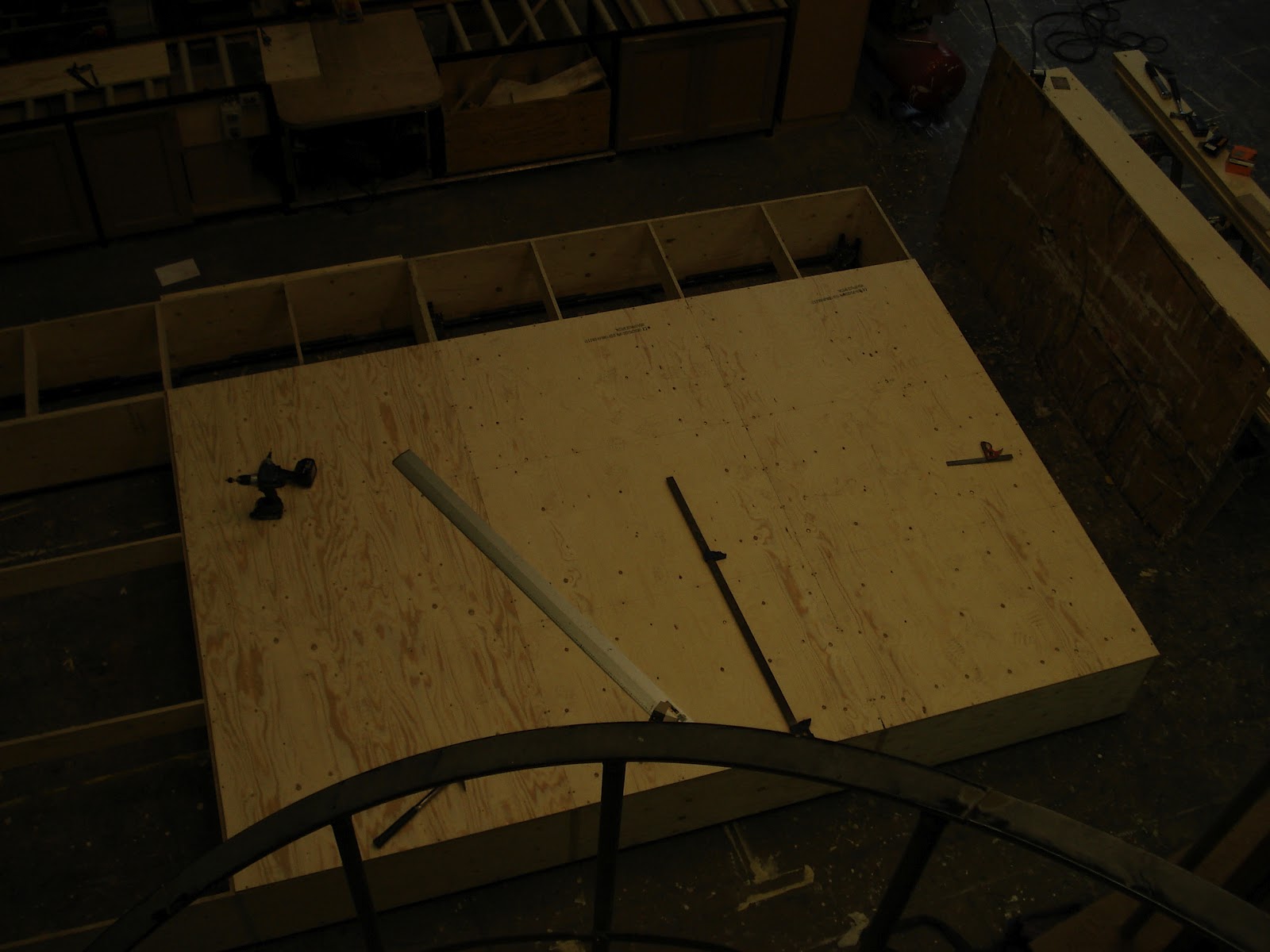

The base was a giant, solidly-welded steel truck (pictured below, surrounded by former components of the Beast where they landed during dismantling) of my own design and construction. Wheels were held in place on beefy plates of 6mm steel burnt onto 2" wide corners. Timber elements were clamped and screwed to uprights on the cross-bracing (welded to resemble an L-beam) to hold the steel straight and hold the plywood together. It all coasted smoothly 20mm off the floor, almost silently.


It was topped with 6 4x8'/500mm platforms, all sound-dampened with a thick layer of brown, flame-retardant underfelt (a pile of it after removal is visible in the back of the photo below) and clad with hundreds of 100mm wide strips of luan painted to look like a silvered hardwood floor. It took two days just to pull all the air staples out of the platform tops (you think we were going to let 6 uncut, unglued sheets of 18mm ply go to waste?), every one of which put up a fight. My hands are covered in cuts and scrapes from the work.

So why is this so remarkable?
It was used for 6 performances over 4 days.
Six.
Monday, August 13, 2012
Bornholm Dukketeaterfestival
Copied from my nonsense blog for the sake of consolidation. From September 12, 2011
 So. I've been out and about. Lighting and puppetry brought me to Denmark this past week. A quick flight got me and the cast of the show I was working on to Copenhagen, and after a few hours of aimless wandering we hopped aboard the night ferry to Bornholm. This little number was equipped with quite comfortable and spacious cabins for a 6-hour trip, with loos And showers. On the top deck you can see the shipping containers that accompanied us from the mainland being efficiently but slowly pulled to the pier. This ferry only does one trip each direction per day and is usually only ridden by a few lorry drivers. The trip back via Ystad, Sweden was only about an hour and was full of passengers and private cars.
 A sample of typical Bornholm fare. These mackerel and herring were smoked on the island by a traditional smoke-house and donated by them to feed the puppet festival folk. It was amazing--seriously, the best fish I've ever eaten. Delicate and perfectly balanced smoke and salt. I had a few handfuls, along with some cheese and some structural bread.
 It is tasty. It is beautiful. It weighs about two kilograms per loaf. It is Danish Bread, and you will not forget it.
 A typical Bornholm home behind Svaneke's community centre, Svanekegaarden. A group of highly talented children performed a fire show and some acrobatics for us out here the first evening we were in town. In addition to smoked fish and a variety of white cheeses, the Danish eat sausages as part of their daily routine, usually shoved into a baguette in a rather humourous way. Use your imagination.
 Another Svaneke home. My camera refused to capture just how vibrantly yellow most of the houses are. I think it's so the locals can find their homes in the snow.
 The Svaneke harbour. It looks like there used to be a bit more of it. For non-Danish speakers, the closest phonetic equivalent is "Sffan-uh-kuh", with an a like in alcohol. If you pronounce it Sven-eekie you will baffle residents. Just FYI.
 Ketch Tecla. Probably 90' on deck, iron hulled. Cute as a button. In Svaneke harbour.
 This house was moving very fast.
 A medieval lamp on display in the Middelaldercenter, near Østerlars. (Eustah-laas). The staff of the Center very kindly allowed us to sleep in and around their grounds, from the office to the cinema to the log cabin covered in medieval-style paintings. Everyone was amazingly nice and patient with all of us lunatics invading their space and sleeping in their workplaces.
 One of my cast (taking a picture) who was hanging out with one of the creatives behind the Hesbjerg Dukketeater's Tommelise, or Thumbelina. This show was a very small, very short, very brightly coloured finger-puppet story for children that we didn't arrive in time to see, but they very nicely allowed us to play all of their musical instruments while we chatted afterwards--including the thumb piano, the bugle, the conch, and one of those nifty single-string instruments that you change the pitch of by squeezing. I didn't ask to play his clarinet though--that just seemed intrusive.
 One of two cockerels who live on site at the Middelaldercenter. A costumed staff member informed me that so long as there are plenty of lady chickens to go around, dude chickens don't fight. So these guys were fit.
 Me in a chain mail hood. Yes. I particularly like the way it fits over my glasses.
 A view of the Middelaldercenter and surrounding countryside from the central tower. We tried to play Rapunzel but nobody could jump high enough to reach my hair. Alas.
 Cockerel number 2. This one had lovely blue plumage but even creepier feet than the others. Bleh. Feathery dinosaurs.
 Wild mushrooms in the forest. No, these were not woods. It was a forest, and you could tell, because of all the fairies and the children dropping bread crumbs and the witches and the wolves in grannies' jammies. No, I did not lick the mushrooms. It was all real!
 Give puppeteers objects, and they will give you puppets. Nice folks. At the Bryghuset i Svaneke. (Brewery)
 The only decent photo I managed to take out the train window on the way from Ystad to Copenhagen. This, dear reader, is in Sweden. The route was a short ferry from Bornholm to Ystad (Uh-sta), Sweden, then an hour's wait (in which I bought some salted liquorice-flavoured chewing gum just for the ew factor but did not get my passport stamped, sadface), then a train to Malmö (Mal-meu), then another train across the Øresund (Eur-sun) Bridge back to Copenhagen, a trip of roughly the same duration as the first from Køge (Cuue) but not nearly as comfortable or convenient. I discovered on this high-tech train that something ugly happened in regard to Cairo and the Israeli embassy, but couldn't figure out who was out to get whom on account of the Swedish news reporting.
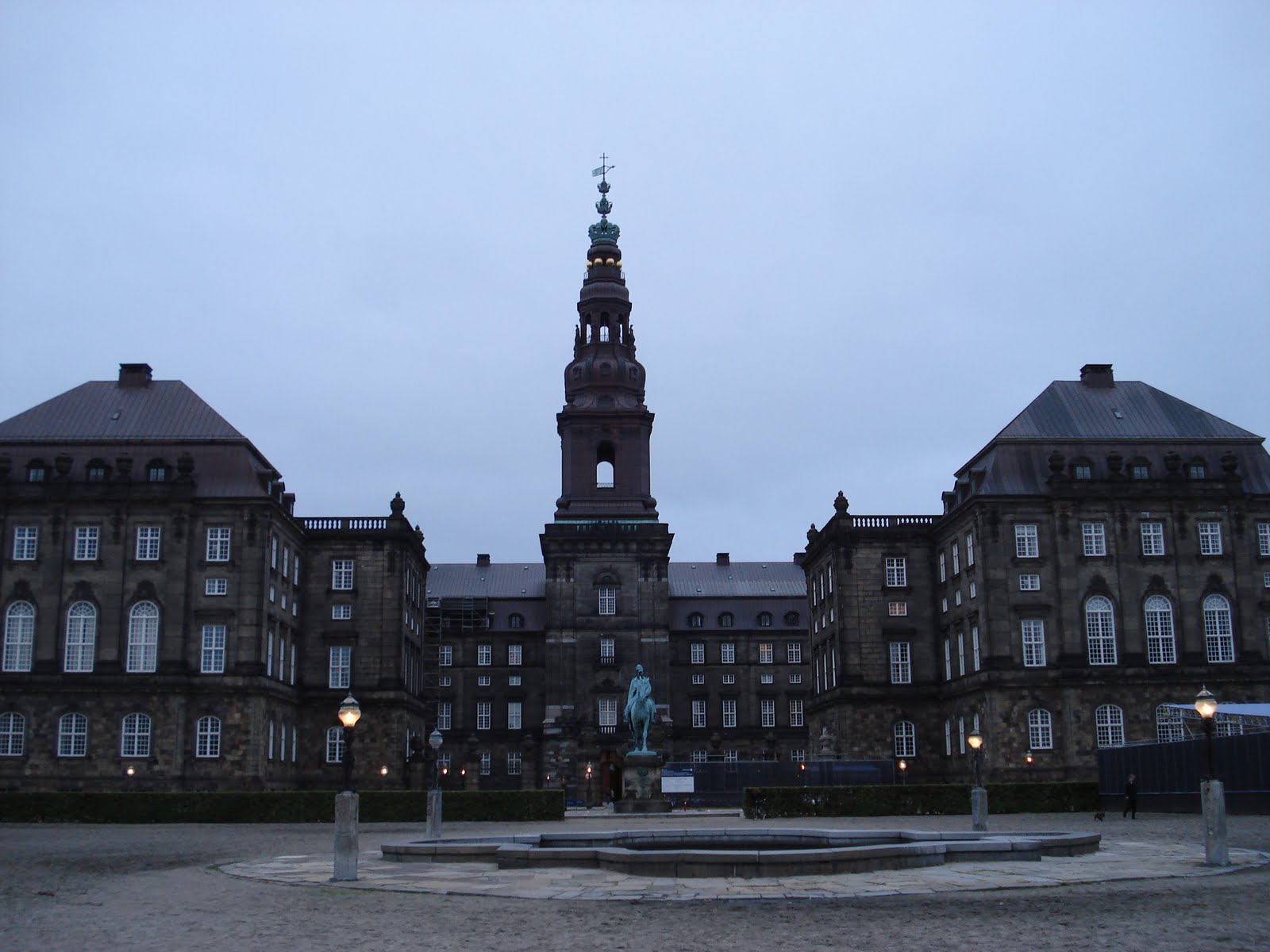
 A shot of the Danish Parliament tower and a few state-esque buildings. I thought it was nice.
 This drawbridge between the Copenhagen city centre and the neighbourhood of Christianshavn is pictured on the 200 kroner note. Interestingly, aside from the 50 kroner note (worth about £6.50 or $9 and will generally buy you one pint of beer) and the 10 and 20 kr coins, there are no people on Danish money. Even the watermark on the 100 and 200 kroner notes is a boat. I found this interesting. And extortionate.
 Someone's front stoop. Sorry person who's house I spent five minutes crouching in front of. I swear I was only admiring your nifty handrails.
 A typical Christianshavn street. Bright colours, neat middle-road streetlights, and a delightfully eclectic mash of buildings surrounded by militant cyclists who defend their raised and well-paved bike lanes with terrifying (though polite) enthusiasm.
 An older, quiet street in Christianshavn, near Christiania. I appreciated that this cyclist thoughtfully bought an antique-style bike to lean against her home for just this sort of photo-op.
 At the end of the same street, second story. Squee.
 This was a really neat neighbourhood, apparently self-governed (provided everyone behaves, I think) that was populated with equal parts stoners and nervous middle-aged people in tour groups. Because everyone is free to sell and smoke light drugs on the streets here, they have a strict no cameras rule. I took a couple of photos away from the populated areas, but resisted temptation otherwise. Which was a shame, because there was some really beautiful street art and other things going on in there.
 We stayed in Christiania for several hours during the interim between our train arriving and our plane leaving. I haven't mentioned yet that we did all of our travel--trains, ferries, boats, buses, cars, walking--carrying a 7' long muslin bag filled with the dismantled components of the puppet show's set. We named it Denise and considered it the most obnoxious and bitchy member of the ensemble. Thankfully for the time in Copenhagen we were able to check Denise and our suitcases into the luggage lockers at the train station or we wouldn't have had nearly as nice a time as we did. I have no idea what this spire goes to but I really liked it and took about 80 pictures of it.
 The Danish Parliament at dusk. It is difficult to tell here, but the ground floor is actually about three stories high--a disconcerting scale-twist that makes the building appear menacing and heavy. It appears to be only about four or five floors high, but is easily triple the height of a normal five-story building. We decided that the reason the Danish government is so nice and good to its people is because they fear the wrath of this building if they screw up.
 Moments before we went back to the airport I noticed this weird anachronism--neat old buildings dotted with flashy-trash LED adverts. I found it very telling of the relationship the Danes seem to have with their neat old buildings--they like them enough to keep them, but they don't find them remarkable enough to not decorate them with ugly contemporary tat.
I really enjoyed my time in Denmark and would love to go back, perhaps after I've learnt a bit more Danish and stocked up on some fruit and vegetables. The regular meals of bread bricks and cheese were always tasty, but after a while I was desperate for some vitamins. The beer is excellent, the fish to die for, the people friendly and happy, and the houses are YELLOW.
Yay Denmark!



I really enjoyed my time in Denmark and would love to go back, perhaps after I've learnt a bit more Danish and stocked up on some fruit and vegetables. The regular meals of bread bricks and cheese were always tasty, but after a while I was desperate for some vitamins. The beer is excellent, the fish to die for, the people friendly and happy, and the houses are YELLOW.
Yay Denmark!
Sunday, January 16, 2011
Blindfolded and Dizzy
This past Tuesday I did a quick bit of lighting design for a performance of Baggage by Fateh Azzam, as part of Horseplay, Proud Camden's monthly theatre event. And let's just say it was...interesting.
The space was unable to give me any idea of what, if anything, of their lighting inventory I could use until about an hour before the performance. I did know I couldn't use anything that wasn't theirs on their rig, could not redirect their power, and couldn't re-program any component of their light board. I had a copy of their inventory that was about 4 years out of date, but no inkling of what was in the air or already in use.
I also had no idea until a few minutes before the final run-through of where in the space the show would be, the shape or size of the playing space, or what the set (if anything) would look like.
The one-act, one-man show was staged on the back wall of...well, they call it an art gallery, but let's be honest. It's a nightclub, complete with stage. The stage, pre-set for bands that evening, had dozens of profiles focused on it that I was forbidden from touching. It also had some fun colour-changeable LED par cans that I couldn't use, LED strips I wouldn't have used if I could, and one of those spinny ball trash lights that gave me The Fear. It was no more and no less than a good setup for a dance club. It was in no way intended for theatre use.
The space also had 5 mini movable lights and 2 mirror scanners, as well as 4 par 56s trained on a metre-wide disco ball in the centre of the room. The pars were ready-coloured with half-amber, half-rust tone gels (i.e. two gels taped together on each fixture) which actually did throw a fairly attractive colour over the entire room if you put them on at full. (The dance club never had them on brightly, but rather kept them at about 40% and got the ball spinning to suggest warmth and movement in all dim corners of the room.)

The control room contained an Avolites Azure Shadow lighting desk, a contraption and interface I had never before laid eyes on. After about ten minutes of poking at it I finally figured out how to isolate instruments and get them to stop spinning around and flashing patterns, and after twenty I had every light I could find steady on the playing space. The mini movables quickly proved useless--at their whitest, brightest, biggest, and furthest out of focus they threw a beam about half a metre across--perfect for crazy shapes on the dance floor, difficult at best for an actor's face to be in at the right time, and mine had twenty minutes. Also, of the five available, 2 worked okay, one could tilt but not pan, one was permanently half-shuttered and lurid red, and one was trapped pointing at the ceiling, never to come down again. Two LED pattern flashers were available, but after five minutes of poking them I couldn't get them to be anything but green. I guess that's what happens to club lx when such rock-out acts as "Whiny and the Synthesizers" and "White Middle Class Rebellion" reach a climax.
So. To say the least, I did what I could. I reined in the mirror scanners, much to their chagrin, and kept them white, big, and stationary. They were helpfully on opposite ends of the other side of the room, so when I roughly centred their beams it looked almost intentional. I kept the mirror ball from spinning and turned up the ambiance lights on it all the way for seating, and when the audience was mostly settled, faded out the rear-most two to suggest the house lights were now off. The front two stayed on so the actor could see the audience's faces, and provided some depth. I faded them down a bit when it seemed appropriate, brought the green LEDs up a trice for fill, and occasionally crossed between the white scanners and the amber room wash to suggest a scene change, but that was about it.

What makes this even more fun was the fact that I was working in program mode. Unable to save anything, and with the board already filled with flashy-trash cues and subs for the lighting-illiterate sound guy to run at random, I worked with the CLEAR button flashing at me constantly, just begging me to bump it and reset everything to default (read: flashy trash). I controlled fades, not just manually, but by selecting the fixtures in the computer and spinning the movable lighting programming wheel in 'dimmer' mode, or punching dim 19 @ full for snaps. Was there a better way? I have no idea. If I never come across an Azure Shadow again it will be too soon.
The audience accepted it, I guess--nothing exploded and they could always see. At least nobody looked particularly surprised or annoyed at how shit the lighting was. I could have done a lot worse with five dimmers (three of which, remember, were on a disco ball) and an hour to learn an entirely alien console. I doubt it would have been possible for me to do much better. At least I didn't push the scanners past 50% on the dimmer--at 51 they start flashing, and at 90 they strobe. That would have been...bad.
The space was unable to give me any idea of what, if anything, of their lighting inventory I could use until about an hour before the performance. I did know I couldn't use anything that wasn't theirs on their rig, could not redirect their power, and couldn't re-program any component of their light board. I had a copy of their inventory that was about 4 years out of date, but no inkling of what was in the air or already in use.
I also had no idea until a few minutes before the final run-through of where in the space the show would be, the shape or size of the playing space, or what the set (if anything) would look like.
The one-act, one-man show was staged on the back wall of...well, they call it an art gallery, but let's be honest. It's a nightclub, complete with stage. The stage, pre-set for bands that evening, had dozens of profiles focused on it that I was forbidden from touching. It also had some fun colour-changeable LED par cans that I couldn't use, LED strips I wouldn't have used if I could, and one of those spinny ball trash lights that gave me The Fear. It was no more and no less than a good setup for a dance club. It was in no way intended for theatre use.
The space also had 5 mini movable lights and 2 mirror scanners, as well as 4 par 56s trained on a metre-wide disco ball in the centre of the room. The pars were ready-coloured with half-amber, half-rust tone gels (i.e. two gels taped together on each fixture) which actually did throw a fairly attractive colour over the entire room if you put them on at full. (The dance club never had them on brightly, but rather kept them at about 40% and got the ball spinning to suggest warmth and movement in all dim corners of the room.)

The control room contained an Avolites Azure Shadow lighting desk, a contraption and interface I had never before laid eyes on. After about ten minutes of poking at it I finally figured out how to isolate instruments and get them to stop spinning around and flashing patterns, and after twenty I had every light I could find steady on the playing space. The mini movables quickly proved useless--at their whitest, brightest, biggest, and furthest out of focus they threw a beam about half a metre across--perfect for crazy shapes on the dance floor, difficult at best for an actor's face to be in at the right time, and mine had twenty minutes. Also, of the five available, 2 worked okay, one could tilt but not pan, one was permanently half-shuttered and lurid red, and one was trapped pointing at the ceiling, never to come down again. Two LED pattern flashers were available, but after five minutes of poking them I couldn't get them to be anything but green. I guess that's what happens to club lx when such rock-out acts as "Whiny and the Synthesizers" and "White Middle Class Rebellion" reach a climax.
So. To say the least, I did what I could. I reined in the mirror scanners, much to their chagrin, and kept them white, big, and stationary. They were helpfully on opposite ends of the other side of the room, so when I roughly centred their beams it looked almost intentional. I kept the mirror ball from spinning and turned up the ambiance lights on it all the way for seating, and when the audience was mostly settled, faded out the rear-most two to suggest the house lights were now off. The front two stayed on so the actor could see the audience's faces, and provided some depth. I faded them down a bit when it seemed appropriate, brought the green LEDs up a trice for fill, and occasionally crossed between the white scanners and the amber room wash to suggest a scene change, but that was about it.

What makes this even more fun was the fact that I was working in program mode. Unable to save anything, and with the board already filled with flashy-trash cues and subs for the lighting-illiterate sound guy to run at random, I worked with the CLEAR button flashing at me constantly, just begging me to bump it and reset everything to default (read: flashy trash). I controlled fades, not just manually, but by selecting the fixtures in the computer and spinning the movable lighting programming wheel in 'dimmer' mode, or punching dim 19 @ full for snaps. Was there a better way? I have no idea. If I never come across an Azure Shadow again it will be too soon.
The audience accepted it, I guess--nothing exploded and they could always see. At least nobody looked particularly surprised or annoyed at how shit the lighting was. I could have done a lot worse with five dimmers (three of which, remember, were on a disco ball) and an hour to learn an entirely alien console. I doubt it would have been possible for me to do much better. At least I didn't push the scanners past 50% on the dimmer--at 51 they start flashing, and at 90 they strobe. That would have been...bad.
Subscribe to:
Posts (Atom)